
ERP Software Pricing Comparison: What to Expect in 2026
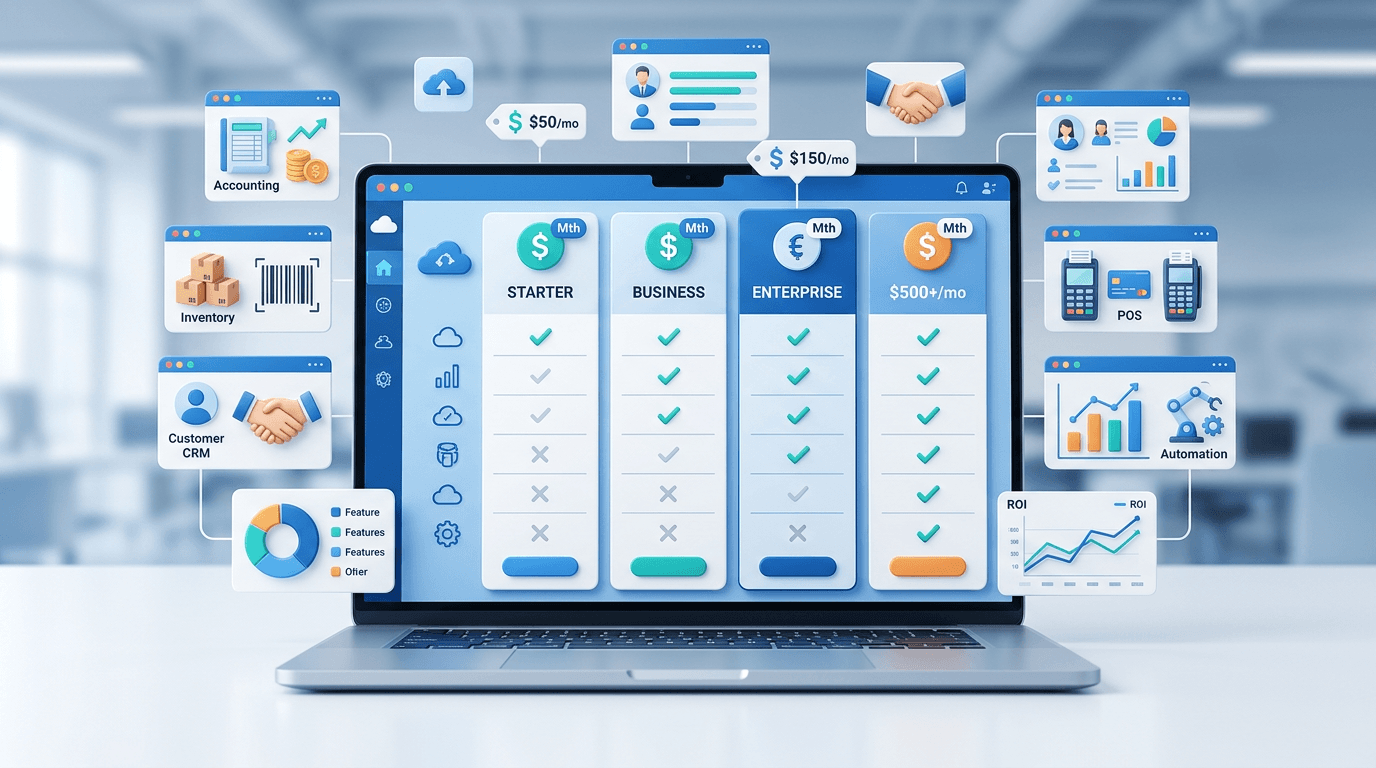
Shopping for ERP software and staring at a blank space where pricing should be? You're not alone. ERP vendors are notorious for hiding costs behind "contact us" forms, and the final bill almost always exceeds the initial quote. This guide cuts through the confusion — covering every pricing model, what typical tiers actually cost, and a side-by-side comparison so you can budget accurately before talking to a single salesperson.
Why ERP Pricing Is So Complicated
Unlike a SaaS subscription where you pay a flat monthly fee, ERP pricing is layered. You're paying for:
- Licenses or subscriptions — the base access fee
- Implementation — setup, data migration, configuration
- Training — getting your team up to speed
- Support & maintenance — ongoing help desk, updates
- Add-on modules — features not included in the base plan
- Hardware — for on-premise systems or POS terminals
A system that looks affordable at $50/user/month can easily cost $200/user/month once you add support, customisation, and the modules you actually need. The sections below decode each component.
The 4 ERP Pricing Models Explained
1. Per-User Subscription (Most Common for Cloud ERP)
You pay a monthly or annual fee for each named user. This is the dominant model for cloud ERP platforms. It scales naturally — add users as you grow — but costs climb quickly for large teams. Watch out for "named user" vs "concurrent user" distinctions: named-user pricing bills every employee who has a login, while concurrent pricing only bills peak simultaneous usage.
Typical range: $20–$300 per user per month, depending on the vendor and modules included.
2. Flat-Fee or Site Licence
One fixed price covers unlimited users at a single business. This model works well for growing SMBs that expect to add staff, because your software cost doesn't increase as headcount grows. Some cloud ERP vendors offer flat-fee tiers capped by revenue band or number of transactions rather than users.
Typical range: $200–$2,000/month for SMB-grade platforms.
3. Open-Source / Free Base with Paid Add-ons
Platforms like Odoo Community and ERPNext offer a free, self-hosted base. The catch: you pay for hosting, IT labour to maintain servers, and premium modules. "Free" open-source ERP commonly costs $5,000–$30,000 in the first year once you factor in setup and customisation.
4. Perpetual Licence (Legacy/On-Premise)
A one-time upfront fee gives you permanent ownership of the software, plus annual maintenance fees (typically 15–22% of the licence cost). This model is fading — most new ERP deployments are cloud-based — but legacy systems like older SAP Business One or Microsoft Dynamics GP still use it.
Typical range: $3,000–$150,000 upfront + 18% annual maintenance.
ERP Price Ranges by Business Size
The table below shows realistic all-in annual costs — licence plus a reasonable implementation allowance — for businesses at each growth stage.
| Business Tier | Employees | Example Platforms | Typical Annual Cost (All-In) |
|---|---|---|---|
| Micro / Startup | 1–10 | EloERP Cloud, Zoho Books, Wave | $0–$3,600 |
| Small Business | 10–50 | EloERP Cloud, Odoo Community, Cin7 | $1,200–$18,000 |
| Growing SMB | 50–200 | Odoo Enterprise, NetSuite Starter, Sage Intacct | $15,000–$60,000 |
| Mid-Market | 200–1,000 | SAP Business One, Microsoft Dynamics 365 BC | $40,000–$250,000 |
| Enterprise | 1,000+ | SAP S/4HANA, Oracle Cloud ERP | $200,000–$2M+ |
Note: "All-in" includes licensing, basic implementation, and first-year support. Custom development, third-party integrations, and extended training add cost.
Detailed ERP Software Pricing Comparison (2026)
Here is a head-to-head breakdown of seven popular ERP and business management platforms, covering their pricing model, starting price, included modules, and key caveats.
| Platform | Model | Starting Price | Core Modules Included | Notable Extras |
|---|---|---|---|---|
| EloERP Cloud | Flat-fee / unlimited users | Contact for pricing | POS, inventory, accounting, payroll, HR, 35+ industry templates | No per-user fee; includes POS hardware integration |
| Odoo Community | Free (self-hosted) + paid modules | $0 (hosting ~$50/mo) | CRM, inventory, accounting basics | Each enterprise module adds $8–$24/user/mo; implementation $5K–$30K |
| Odoo Enterprise | Per user | ~$31/user/mo | All modules included | Minimum ~5 users; $5K–$20K implementation |
| ERPNext (Frappe Cloud) | Per user | $50/user/mo (cloud) | Accounting, inventory, HR, manufacturing | Self-host free; cloud plan includes support |
| Zoho One | Per user | $37/user/mo (annual) | 45+ Zoho apps (CRM, Books, Inventory, HR) | Not a true ERP; strong for <50 users with simple ops |
| NetSuite | Platform fee + per user | ~$999/mo base + $99/user | Financials, CRM, inventory, e-commerce | $10K–$50K implementation; contracts typically 2–3 years |
| SAP Business One | Per user (cloud or perpetual) | ~$108/user/mo (cloud) | Financials, inventory, sales, production | Partner-delivered only; $15K–$100K implementation |
What's Usually NOT Included in the Base Price
One of the most common ERP budgeting mistakes is treating the licence cost as the total cost. Here are the common add-ons that drive the real bill higher:
- Data migration — Moving legacy data from spreadsheets, QuickBooks, or old ERP to the new system. Expect $1,000–$15,000 depending on data volume and cleanliness.
- Custom reports and dashboards — Standard reports rarely match every business's needs. Custom BI work adds $500–$5,000+.
- Third-party integrations — Connecting to Shopify, WooCommerce, couriers, or accounting platforms costs $500–$10,000 per integration if not natively supported.
- User training — Formal training workshops run $500–$3,000 per session. Factor in 8–20 hours of employee time per user.
- Ongoing customisation — Business processes change. Ongoing development retainers run $1,000–$5,000/month for mid-size deployments.
- Premium support — Basic email support is often included, but phone/priority support costs $200–$1,000/month extra.
How to Calculate Total Cost of Ownership (TCO)
Use this simple three-year TCO formula when comparing ERP options:
TCO (3 years) =
  (Monthly licence × 36)
+ Implementation cost
+ Training cost
+ Year 1 customisation
+ Annual support fees × 3
+ Estimated add-on modules × 36 months
Example: A 20-user Odoo Enterprise deployment at $31/user/month looks like this over three years:
- Licence: $31 × 20 users × 36 months = $22,320
- Implementation: $12,000
- Training: $2,000
- Support (included): $0
- 2 custom integrations: $4,000
- 3-year TCO: ~$40,320
Compare this to a flat-fee platform where implementation is streamlined and per-user fees are absent — the gap widens dramatically as headcount grows.
EloERP Cloud Pricing: What You Get
EloERP Cloud is built specifically for retail, wholesale, and service SMBs across 35+ industries. Unlike per-user platforms that penalise growth, EloERP uses a flat-fee model — your monthly cost stays predictable as you add cashiers, warehouse staff, or branch managers.
The platform bundles capabilities that competitors charge extra for:
- Multi-location POS with offline mode
- Full inventory management with batch and expiry tracking
- Integrated accounting and financial reports
- Payroll and HR management
- Industry-specific templates for pharmacy, grocery, garments, jewelry, restaurants, and 30+ more
- WhatsApp and SMS customer communication
- Free setup assistance and onboarding
For full details and current pricing, visit the EloERP pricing page. A free demo is available — no credit card required.
5 Questions to Ask Before Signing Any ERP Contract
- Is the price per named user or concurrent user? Named-user pricing is costlier for teams where not everyone is logged in simultaneously.
- What modules are included, and what costs extra? Get a full feature list in writing — verbal assurances don't survive contract renewals.
- What is the implementation estimate, and is it fixed or time-and-materials? Time-and-materials contracts can balloon; fixed-price implementations protect your budget.
- What happens to your data if you cancel? Ensure you can export all data in a standard format (CSV, XML) at any time.
- Is there a price lock? SaaS vendors routinely raise prices 10–20% annually. Negotiate a multi-year price lock or cap.
Red Flags in ERP Pricing Quotes
- "Contact us for pricing" with no ballpark range — often signals enterprise-only pricing that's out of SMB reach
- Very low per-user price with many required add-ons — the "razor and blades" model; calculate total cost with all modules you need
- Implementation not itemised — a vague "implementation included" claim should be probed: how many hours, what's in scope, what's a change request?
- Short free trial with no sandbox data — 14-day trials rarely reveal complexity; push for a 30-day trial with real test data
- Auto-renewal clauses without price caps — read the contract; some ERP agreements allow unlimited annual price increases
How to Calculate ERP ROI for Your Business
ROI is the ultimate justification for any ERP investment. A straightforward framework:
- Labour savings: How many hours per week does your team spend on manual data entry, reconciliation, and reporting? Multiply by average hourly cost. A 10-person retail team spending 5 hours each per week on admin = 50 hours × $15/hr = $750/week = $39,000/year.
- Shrinkage reduction: ERP inventory controls typically reduce shrinkage by 15–30%. If you carry $500,000 in inventory with 3% shrinkage ($15,000/year), a 20% reduction saves $3,000 annually.
- Faster closing cycles: Businesses report cutting month-end close from 10 days to 2 days. That's an extra 8 days of finance team productivity per month.
- Reduced stockouts: Automated reorder points reduce lost sales. Even a 5% improvement in in-stock rate can recover thousands in revenue for retail businesses.
Add those savings up, subtract your 3-year TCO, and you have a defensible ROI case to present to stakeholders.
Bottom Line: What ERP Software Should Cost Your Business
The ERP pricing landscape ranges from genuinely free (with real hidden costs) to millions per year for enterprise behemoths. For SMBs in retail, wholesale, and service industries, the sweet spot is a cloud platform with transparent flat-fee or low per-user pricing, bundled core modules, and included support.
Before committing, build your 3-year TCO, ask the five contract questions above, and run a genuine pilot with your own data. The ERP you choose will run your business for 5–10 years — getting the price right from day one matters.
Ready to see where EloERP fits your budget? View our transparent pricing or book a free 30-minute demo — no sales pressure, no hidden fees.